
Introduction
Have you ever wondered why some people seem to accomplish more in a day than others do in a week?
While talent, intelligence, and experience certainly play a role, one factor consistently appears among top achievers across industries: a powerful morning routine.
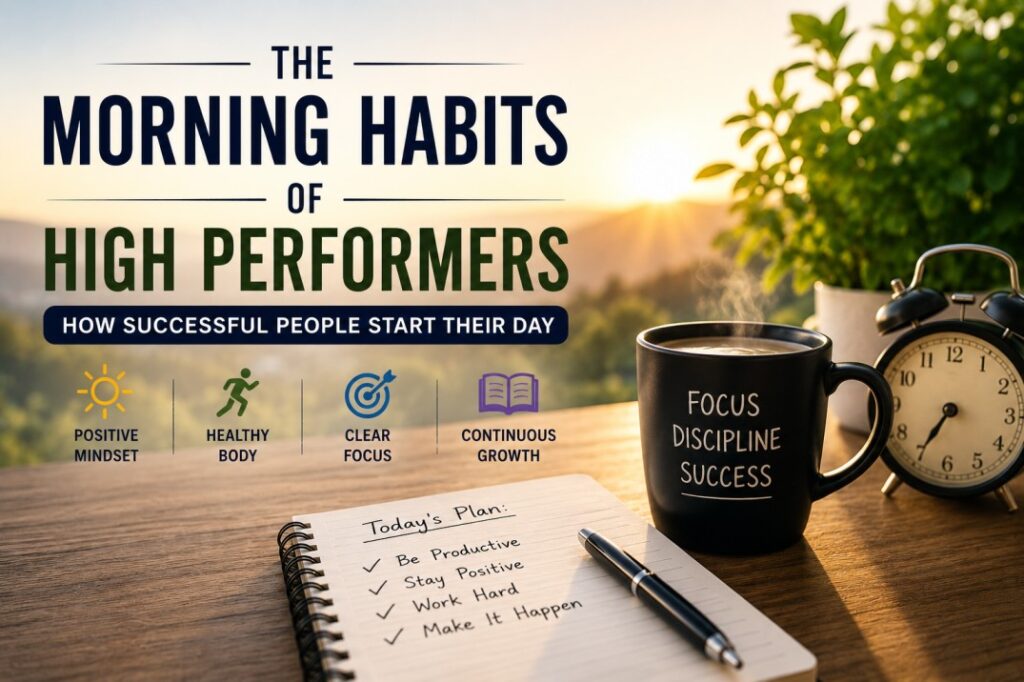
From CEOs and entrepreneurs to athletes and thought leaders, high performers understand that how they begin their day often determines how the rest of it unfolds. The morning hours provide a unique opportunity to set intentions, build momentum, and prepare both the mind and body for peak performance.
The good news is that you don’t need a perfect schedule or a 5 a.m. wake-up call to benefit from these habits. What matters most is consistency and intentionality.
In this article, we’ll explore the morning habits commonly practiced by high performers and how you can incorporate them into your own life.
Why Morning Habits Matter
The first few hours after waking are often the most influential part of the day.
During this time, your brain is relatively free from distractions, decision fatigue, and external demands. A structured morning routine can help you:
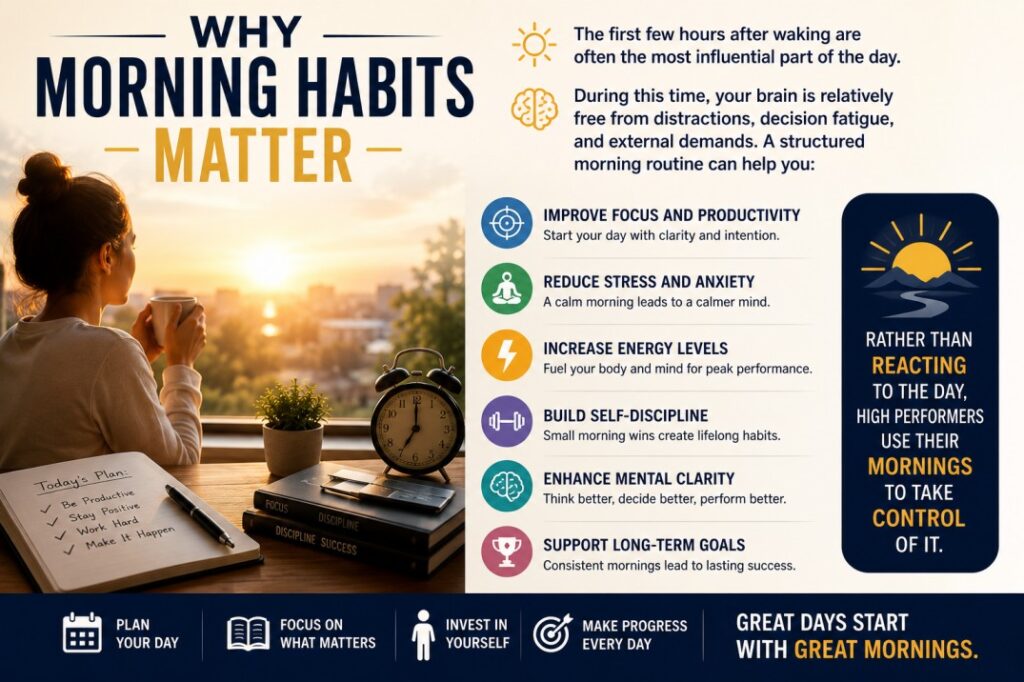
- Improve focus and productivity
- Reduce stress and anxiety
- Increase energy levels
- Build self-discipline
- Enhance mental clarity
- Support long-term goals
Rather than reacting to the day, high performers use their mornings to take control of it.
1. Wake Up with Purpose
Successful people don’t necessarily wake up earlier than everyone else—they wake up intentionally.
Instead of hitting the snooze button multiple times, they rise with a clear reason for starting the day.
Why It Works
When you wake up with a purpose, you begin the day proactively rather than passively.
Benefits include:
- Increased motivation
- Better mood
- Greater productivity
- Improved consistency
How to Apply It
Before going to bed, identify one important reason to get out of bed the next morning.
This could be:
- Completing a project
- Exercising
- Learning a skill
- Working toward a long-term goal
2. Avoid Checking Your Phone Immediately
One of the most common habits among high performers is protecting their attention in the morning.
Many avoid social media, emails, and news notifications during the first part of the day.
The Problem with Instant Phone Use
Checking your phone immediately after waking can:
- Increase stress
- Trigger distractions
- Reduce focus
- Encourage reactive behavior
Instead of directing your attention toward your priorities, you allow external demands to control your mindset.
Better Alternative
Spend the first 30–60 minutes of your day offline whenever possible.
Use this time for activities that support your wellbeing and goals.
3. Hydrate First Thing in the Morning
After several hours of sleep, your body naturally becomes dehydrated.
Many high performers begin the day by drinking water before consuming coffee or breakfast.
Benefits of Morning Hydration
Hydration supports:
- Brain function
- Energy levels
- Concentration
- Digestion
- Physical performance
Even mild dehydration can negatively affect mood and mental clarity.
Simple Habit
Keep a glass or bottle of water near your bed and drink it shortly after waking.
4. Move Your Body
Exercise is one of the most powerful habits shared by high achievers.
Morning movement doesn’t have to involve an intense workout.
The goal is to activate both the body and mind.
Benefits of Morning Exercise
Physical activity can:
- Increase energy
- Improve mood
- Enhance focus
- Reduce stress
- Boost confidence
Exercise also stimulates the release of endorphins and other brain chemicals associated with wellbeing.
Ideas
- Walking
- Yoga
- Stretching
- Strength training
- Cycling
- Running
Even 10–20 minutes can make a difference.
5. Practice Mindfulness or Meditation
Many successful individuals prioritize mental fitness just as much as physical fitness.
Meditation and mindfulness help create mental clarity before the demands of the day begin.
Benefits
Regular mindfulness practice may:
- Reduce anxiety
- Improve emotional regulation
- Increase concentration
- Enhance self-awareness
- Lower stress levels
How to Start
Begin with:
- Five minutes of deep breathing
- Guided meditation
- Quiet reflection
- Mindful journaling
Consistency matters more than duration.
6. Review Goals and Priorities
High performers don’t leave their day to chance.
They start by reviewing what matters most.
Why This Matters
Without clear priorities, it’s easy to spend the day reacting to emails, notifications, and other people’s requests.
Reviewing goals helps ensure your actions align with your long-term vision.
Effective Questions
Ask yourself:
- What are my top priorities today?
- What outcome would make today successful?
- What task deserves my best energy?
7. Eat a Brain-Boosting Breakfast
Nutrition plays a critical role in cognitive performance.
Many high performers choose nutrient-dense foods that provide sustained energy rather than sugary options that cause crashes later.
Healthy Breakfast Ideas
- Eggs and vegetables
- Oatmeal with berries
- Greek yogurt and nuts
- Whole-grain toast with avocado
- Smoothies with protein and fruit
Benefits
A balanced breakfast can support:
- Concentration
- Memory
- Stable energy levels
- Productivity
8. Read Something Valuable
Many successful people dedicate time each morning to learning.
Reading allows them to expand knowledge, gain new perspectives, and maintain continuous growth.
What to Read
- Books
- Industry news
- Educational articles
- Research papers
- Personal development content
Even 10 pages per day can lead to significant learning over time.
9. Journal for Clarity
Journaling is a common practice among entrepreneurs, executives, and creative professionals.
Writing helps organize thoughts and reduce mental clutter.
Benefits
Journaling can:
- Improve self-awareness
- Reduce stress
- Clarify goals
- Enhance creativity
- Strengthen decision-making
Prompts
Consider writing:
- Three things you’re grateful for
- Your main goal for the day
- Challenges you’re currently facing
- Lessons you’re learning
10. Tackle Important Work Early
High performers often dedicate their most productive hours to meaningful work.
Instead of starting with easy tasks, they focus on high-impact activities first.
Why It Works
Willpower and mental energy tend to decline throughout the day.
By addressing important tasks early, you leverage peak focus and concentration.
The “Most Important Task” Strategy
Identify one task that would make the biggest positive impact if completed today.
Start with that task before distractions take over.
11. Limit Decision Fatigue
Many successful people simplify their mornings to conserve mental energy.
Examples include:
- Preparing clothes the night before
- Planning meals in advance
- Following consistent routines
The fewer unnecessary decisions you make, the more energy remains for meaningful work.
12. Practice Gratitude
Gratitude is a surprisingly powerful habit among high performers.
Starting the day with appreciation can positively influence mindset and emotional wellbeing.
Benefits
Research suggests gratitude may:
- Increase happiness
- Reduce stress
- Improve relationships
- Enhance resilience
Simple Practice
Write down three things you’re grateful for every morning.
They don’t have to be major achievements.
Small moments matter too.
Common Morning Mistakes to Avoid
Even productive people can sabotage their mornings through unhealthy habits.
Common mistakes include:
Hitting Snooze Repeatedly
This can leave you feeling groggy and less alert.
Starting with Social Media
It often creates distraction and comparison.
Skipping Breakfast
May lead to energy crashes later.
Having No Plan
Without direction, productivity suffers.
Rushing Through the Morning
A chaotic start often creates a stressful day.
Creating Your Own High-Performance Morning Routine
You don’t need to adopt every habit at once.
Start small and build gradually.
Sample Morning Routine
6:30 AM – Wake up and drink water
6:35 AM – Stretch or exercise
7:00 AM – Meditation or mindfulness
7:10 AM – Review goals
7:20 AM – Healthy breakfast
7:40 AM – Reading or journaling
8:00 AM – Begin important work
Adjust the schedule according to your lifestyle and responsibilities.
The Power of Consistency
The true secret behind high performers isn’t perfection.
It’s consistency.
Small actions repeated daily create remarkable long-term results.
A productive morning routine won’t transform your life overnight, but over months and years, it can significantly improve your focus, health, productivity, and overall success.
Conclusion
High performers understand that success often begins before the workday starts.
By intentionally designing their mornings, they create a foundation for better decisions, higher productivity, and improved wellbeing.
Whether it’s hydrating, exercising, meditating, reading, journaling, or focusing on meaningful work, these habits help create momentum that lasts throughout the day.
Start with one or two habits that resonate with you, practice them consistently, and gradually build a routine that supports your goals.
Remember, the goal isn’t to copy someone else’s morning—it’s to create one that helps you become your best self.
Frequently Asked Questions (FAQs) – The Morning Habits of High Performers: How Successful People Start Their Day
1. Why are morning habits important for success?
Morning habits help set the tone for the rest of the day. A structured routine can improve focus, productivity, energy levels, mental clarity, and overall wellbeing.
2. Do all successful people wake up early?
Not necessarily. While many high performers wake up early, success is more about consistency and intentionality than a specific wake-up time. The key is creating a routine that supports your goals.
3. What is the first thing high performers do in the morning?
Many high performers start their day by hydrating, exercising, meditating, journaling, or reviewing their priorities before checking emails or social media.
4. Why do successful people avoid checking their phones immediately after waking up?
Checking your phone first thing in the morning can increase stress, distractions, and reactive thinking. High performers often protect their attention by focusing on their own priorities before engaging with external demands.
5. How does drinking water in the morning help performance?
After several hours of sleep, the body becomes dehydrated. Drinking water helps support brain function, concentration, energy levels, and overall physical performance.
6. Is exercise an essential part of a high-performance morning routine?
Many successful people include some form of movement in their mornings because exercise boosts energy, improves mood, enhances focus, and reduces stress.
7. How much exercise should I do in the morning?
Even 10–20 minutes of physical activity can be beneficial. Activities such as walking, stretching, yoga, or strength training can help activate both the body and mind.
8. Why do high performers practice meditation or mindfulness?
Mindfulness practices can improve focus, emotional regulation, stress management, and self-awareness, helping individuals approach the day with greater clarity and calmness.
9. How long should a morning meditation session be?
Beginners can start with just 5 minutes. Consistency is often more important than duration.
10. Why is goal review important in the morning?
Reviewing goals helps ensure that your daily actions align with your long-term objectives and prevents you from getting distracted by less important tasks.
11. What is the “Most Important Task” strategy?
The Most Important Task (MIT) strategy involves identifying the single task that will have the greatest positive impact on your day and tackling it early when your energy and focus are highest.
12. Do successful people eat breakfast?
Many high performers choose a nutritious breakfast that provides sustained energy and supports cognitive function. However, individual preferences and dietary approaches may vary.
13. What are some brain-boosting breakfast options?
Healthy breakfast choices include:
- Eggs and vegetables
- Oatmeal with berries
- Greek yogurt and nuts
- Avocado toast
- Protein smoothies
14. Why do successful people read in the morning?
Reading allows continuous learning, personal growth, and exposure to new ideas. Even a few pages each day can accumulate into substantial knowledge over time.
15. How does journaling improve performance?
Journaling helps organize thoughts, clarify goals, reduce stress, enhance creativity, and improve decision-making.
16. What should I write about in a morning journal?
Common journaling topics include:
- Gratitude lists
- Daily goals
- Personal reflections
- Challenges and solutions
- Lessons learned
17. What is decision fatigue?
Decision fatigue occurs when mental energy decreases after making numerous decisions. High performers often simplify their mornings to conserve energy for more important tasks.
18. How can I reduce decision fatigue in the morning?
You can reduce decision fatigue by:
- Planning the day ahead
- Preparing clothes the night before
- Meal prepping
- Following a consistent routine
19. Why is gratitude part of many successful morning routines?
Gratitude can improve mood, reduce stress, increase resilience, and foster a more positive outlook throughout the day.
20. What are common morning habits that hurt productivity?
Common mistakes include:
- Repeatedly hitting the snooze button
- Checking social media immediately
- Skipping breakfast
- Having no plan for the day
- Rushing through the morning
21. How long should a morning routine be?
A morning routine can range from 15 minutes to several hours. The most effective routine is one that fits your lifestyle and can be maintained consistently.
22. Do I need to follow every habit mentioned in the article?
No. It’s better to start with one or two habits and gradually build a routine that works for your goals, schedule, and personal preferences.
23. Can a morning routine improve mental health?
Yes. Activities such as exercise, meditation, journaling, gratitude, and goal-setting may help reduce stress and improve emotional wellbeing.
24. How long does it take to see results from a morning routine?
Many people notice improvements in mood, energy, and focus within a few days or weeks. Long-term benefits often become more apparent with consistent practice over months.
25. What is the biggest lesson from high performers’ morning habits?
The biggest lesson is that success often comes from consistent daily actions. A purposeful morning routine helps create momentum, improve productivity, and support long-term personal and professional growth.
26. Is waking up at 5 AM necessary for success?
No. While some successful individuals wake up at 5 AM, there is no universal wake-up time that guarantees success. What matters most is getting enough sleep and using your morning intentionally.
27. Can morning routines help improve focus and concentration?
Yes. Habits like exercise, meditation, healthy eating, and planning your day can improve attention, mental clarity, and productivity.
28. What should I do if I struggle to maintain a morning routine?
Start small. Focus on one habit, make it easy to perform, and build consistency before adding additional habits.
29. How can busy professionals develop a morning routine?
Even a short routine can be effective. For example:
- Drink water
- Stretch for 5 minutes
- Review daily goals
- Eat a healthy breakfast
This can take less than 20 minutes.
30. What is the most important takeaway from successful morning routines?
The most important takeaway is that intentional mornings create productive days. Small, consistent habits performed each morning can significantly improve your focus, health, mindset, and long-term success.
References
The following references can be included at the end of “The Morning Habits of High Performers: How Successful People Start Their Day” to support the article with evidence-based research on productivity, habit formation, psychology, sleep, focus, and peak performance.
Books and Personal Development Literature
- Clear, J. (2018). Atomic Habits: An Easy & Proven Way to Build Good Habits and Break Bad Ones. Avery.
- Duhigg, C. (2014). The Power of Habit: Why We Do What We Do in Life and Business. Random House.
- Covey, S. R. (2020). The 7 Habits of Highly Effective People (30th Anniversary Edition). Simon & Schuster.
- Newport, C. (2016). Deep Work: Rules for Focused Success in a Distracted World. Grand Central Publishing.
- McKeown, G. (2014). Essentialism: The Disciplined Pursuit of Less. Crown Business.
- Hal Elrod. (2023). The Miracle Morning: The Not-So-Obvious Secret Guaranteed to Transform Your Life Before 8 AM. BenBella Books.
- Keller, G., & Papasan, J. (2013). The One Thing: The Surprisingly Simple Truth Behind Extraordinary Results. Bard Press.
Scientific Journals and Research
- Journal of Behavioral Medicine. Research on habit formation, routines, and behavioral change.
- Psychological Science. Studies on self-control, productivity, and decision-making.
- Sleep. Research on sleep quality, cognitive performance, and daily functioning.
- Journal of Occupational Health Psychology. Studies on productivity, stress management, and workplace performance.
- Frontiers in Psychology. Research on mindfulness, attention, and mental wellbeing.
- American Journal of Lifestyle Medicine. Studies on exercise, wellness, and healthy routines.
- International Journal of Behavioral Nutrition and Physical Activity. Research on physical activity and daily performance.
Health and Productivity Organizations
- World Health Organization (WHO) Health and Well-Being Resources
- Centers for Disease Control and Prevention (CDC) Healthy Living Resources
- National Institutes of Health (NIH) Wellness and Prevention Resources
- Harvard Health Publishing
- Mayo Clinic Healthy Lifestyle Resources
- American Psychological Association (APA) Mental Health Resources
Sleep, Mindfulness, and Performance Resources
- National Sleep Foundation
- Johns Hopkins Medicine Wellness and Prevention Resources
- Cleveland Clinic Health Essentials
- Mindful.org Mindfulness Resources
- Greater Good Science Center, University of California Berkeley
Further Reading
- Atomic Habits by James Clear
- The Power of Habit by Charles Duhigg
- Deep Work by Cal Newport
- The Miracle Morning by Hal Elrod
- The 7 Habits of Highly Effective People by Stephen R. Covey