
It’s 11:30 PM. You got into bed thirty minutes ago, promising yourself you’d check your notifications for “just a second” before sleeping.
Now, the room is dark, your face is illuminated by the harsh blue glow of your screen, and your thumb is moving in a rhythmic, repetitive swipe. You aren’t even really watching the videos anymore. You aren’t laughing. You aren’t learning. You are just… existing.
Welcome to the world of Zombie Scrolling.
In this post, we’re going to dissect what happens to your brain when you enter this trance, why apps are designed to keep you there, and how you can wake up and take back your time.
What is Zombie Scrolling?
Zombie Scrolling (often overlapping with “Doomscrolling”) is the act of mindlessly consuming content on social media feeds without specific intent or enjoyment. It is a state of passive consumption where the user enters a “flow state” of nothingness—your body is present, but your mind is on autopilot.
Unlike active browsing (searching for a recipe, replying to a friend), Zombie Scrolling is characterized by a lack of emotional reaction. You are simply feeding the algorithm.
The Science: Why We Can’t Stop
You aren’t weak-willed; you are fighting against some of the smartest engineers and psychologists in the world. The “Infinite Scroll” was designed to exploit specific glitches in the human brain.
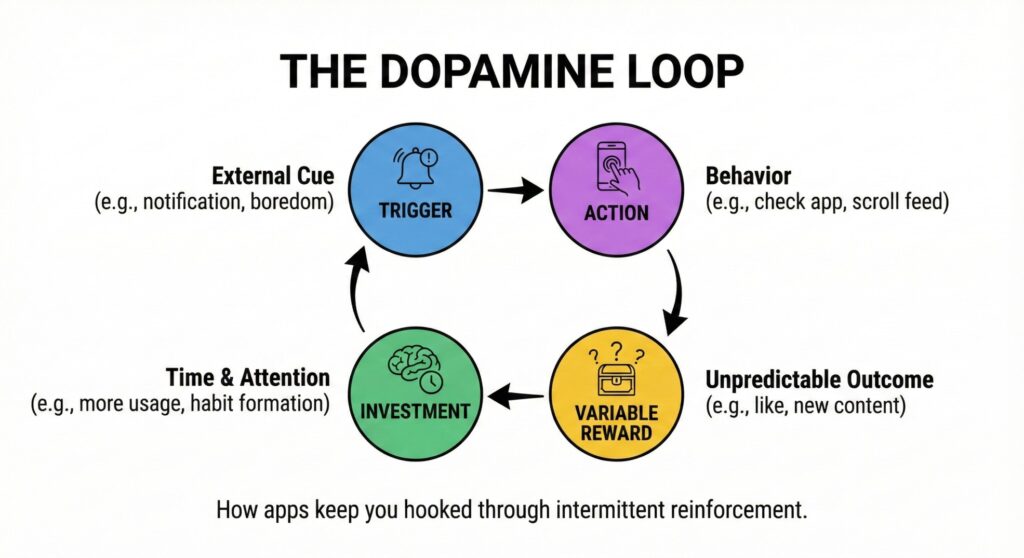
Every time you swipe up, your brain anticipates a reward. A funny meme? A shocking news headline? An attractive person?
1. The Dopamine Loop
- When you see something you like, Your brain releases dopamine (the pleasure chemical).
- When you see something boring, You swipe immediately to find the next hit.
This creates a Dopamine Feedback Loop. Your brain starts craving the action of swiping, not just the content itself.
2. Variable Rewards (The Slot Machine Effect)
Psychologist B.F. Skinner discovered that the most effective way to reinforce a behavior is Intermittent Reinforcement. If you won a prize every time you pulled a slot machine lever, you’d get bored. But because you only win sometimes, you keep pulling. Social media is a digital slot machine. You don’t know whether the next post will be a “win” (a viral video) or a “loss” (a boring ad). That uncertainty keeps you glued to the screen.

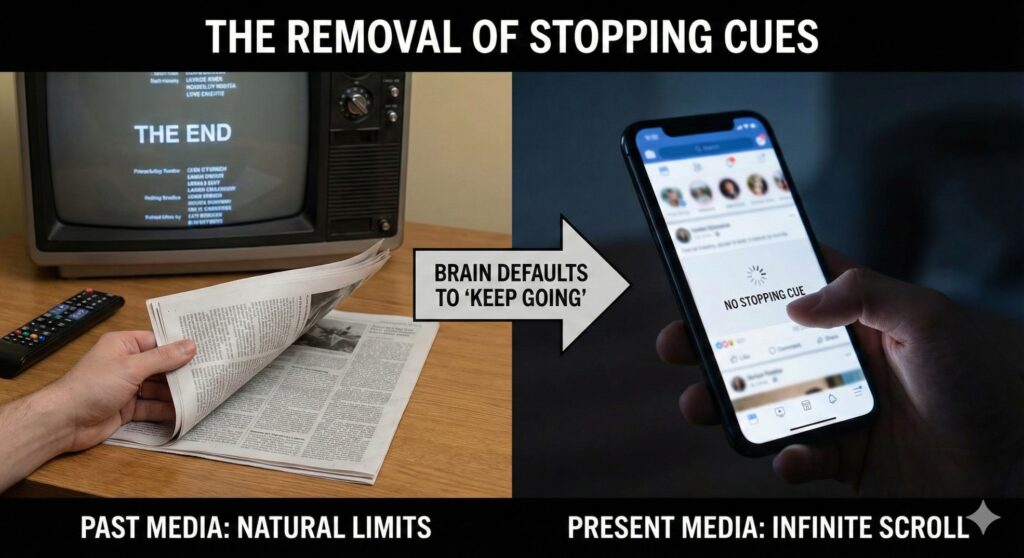
3. The Removal of “Stopping Cues.”
In the past, the media had natural stopping points. A newspaper has a last page. A TV show has credits. Infinite Scroll removes the stopping cue. There is no bottom of the page. The app never tells you, “That’s enough for today.” Without a visual signal to stop, our brains default to the path of least resistance: keep going.
The Cost of Being a Zombie
While it feels harmless in the moment, chronic Zombie Scrolling has severe side effects:
- “Popcorn Brain”: Your attention span fragments. You become so used to 15-second clips that watching a 2-hour movie or reading a book feels physically painful.
- Sleep Procrastination: The blue light suppresses melatonin, and the dopamine keeps your brain alert, leading to poor quality sleep and insomnia.
- The Numbness Factor: Overconsumption leads to emotional blunting. You see a tragedy next to a cat video next to a dance trend. Your brain stops processing the emotional weight of what you are seeing.
How to Break the Spell (Practical Steps)
You don’t need to delete all your apps to stop being a zombie. You just need to introduce Friction.
1. The “Grayscale” Hack
Go into your phone’s Accessibility settings and turn your screen to Grayscale (Black and White). Apps like Instagram and TikTok rely on bright red notifications and vibrant videos to stimulate your brain. When you strip the color away, the app looks boring. You’ll be amazed at how quickly you lose the urge to scroll.
2. Physical Pattern Interrupts
When you catch yourself zombie scrolling, physically change your state:
- Stand up.
- Drop the phone on the couch (literally let go of it).
- Say out loud: “I am zombie scrolling.” This breaks the trance and engages your prefrontal cortex (the logical part of your brain).
3. Set “Hard” Stopping Cues
Since the app won’t stop you, you must stop yourself.
- Use App Timers: Set a limit of 15 minutes. When the time is up, the app locks.
- The “One Video” Rule: If you open YouTube to watch a specific tutorial, watch that one video and close the app immediately. Do not look at the “Suggested” sidebar.
Conclusion: Be the User, Not the Product
Technology is a tool, but when we zombie scroll, we become the tool. The goal isn’t to hate social media—it’s to use it with intention.
Next time you pick up your phone, ask yourself: “Am I looking for something specific, or am I just looking to be distracted?”
If the answer is distraction, put the phone down. Go look out a window, pet your dog, or make a cup of tea. The real world is high-definition, uncurated, and happening right now. Don’t miss it.
Are you guilty of late-night zombie scrolling? Share your worst “time-warp” story in the comments below!
Frequently Asked Questions (FAQs)
1. What is a “Zombie Scroller”?
A “Zombie Scroller” is someone who mindlessly scrolls through social media, news feeds, videos, or online content for extended periods without a clear purpose, often losing track of time and feeling mentally drained afterward.
2. What is infinite scrolling?
Infinite scrolling is a design feature used by many apps and websites where new content continuously loads as you scroll, eliminating natural stopping points and encouraging prolonged engagement.
3. Why is endless scrolling so addictive?
Infinite feeds are designed to trigger the brain’s reward system. Unpredictable content and occasional interesting posts create a cycle of anticipation and reward that encourages users to keep scrolling.
4. How does excessive scrolling affect the brain?
Excessive scrolling can contribute to:
- Reduced attention span
- Mental fatigue
- Increased stress and anxiety
- Information overload
- Difficulty focusing on important tasks
- Sleep disturbances
5. How can I tell if I’m a zombie scroller?
Common signs include:
- Checking your phone automatically
- Losing track of time online
- Scrolling when bored or stressed
- Difficulty concentrating without digital stimulation
- Feeling mentally exhausted after using social media
6. Is social media inherently bad?
No. Social media can be useful for communication, learning, networking, and entertainment. Problems typically arise when usage becomes excessive or unconscious.
7. What is doomscrolling?
Doomscrolling refers to continuously consuming negative news or distressing content online, often leading to increased anxiety, stress, and feelings of helplessness.
8. How much screen time is considered too much?
There is no universal number, but screen time becomes problematic when it interferes with sleep, work, relationships, physical activity, or mental wellbeing.
9. Why do I reach for my phone without thinking?
This behavior is often driven by habit loops. Over time, your brain associates certain triggers—such as boredom, stress, or waiting—with checking your phone.
10. Can excessive scrolling impact mental health?
Yes. Research suggests excessive social media use may be associated with anxiety, stress, loneliness, low self-esteem, and increased social comparison.
11. How does scrolling affect productivity?
Constant interruptions from social media and notifications can reduce focus, increase task-switching, and make it harder to complete meaningful work efficiently.
12. Can scrolling affect sleep quality?
Yes. Late-night screen use can interfere with sleep by exposing you to stimulating content and blue light, making it harder to fall asleep and achieve quality rest.
13. What are the benefits of reducing screen time?
Benefits may include:
- Improved focus
- Better sleep
- Reduced stress
- Increased productivity
- More free time
- Better relationships
- Enhanced mindfulness
14. What is a digital detox?
A digital detox is a temporary break from non-essential technology use, particularly social media, online entertainment, and excessive smartphone use.
15. Do I need to quit social media completely?
Not necessarily. Many people benefit from setting boundaries, limiting usage, and using social media intentionally rather than eliminating it entirely.
16. How can I stop mindless scrolling?
Try these strategies:
- Turn off unnecessary notifications
- Set app time limits
- Remove distracting apps from your home screen
- Create phone-free periods during the day
- Replace scrolling with healthier activities
17. What should I do instead of scrolling?
Consider:
- Reading books
- Walking outdoors
- Exercising
- Journaling
- Learning a new skill
- Spending time with family and friends
- Practicing meditation
18. Why do social media platforms want users to stay engaged?
Most social platforms generate revenue through advertising. The longer users remain on the platform, the more opportunities exist to display ads and collect engagement data.
19. Can reducing scrolling improve focus?
Yes. Limiting distractions helps your brain sustain attention for longer periods and improves your ability to engage in deep, meaningful work.
20. How long does it take to break a scrolling habit?
The timeline varies by individual, but many people notice improvements in awareness, focus, and screen-time control within a few days or weeks of making intentional changes.
21. What is the connection between scrolling and dopamine?
Interesting or unexpected content can trigger dopamine release, creating a reward cycle that encourages repeated checking and scrolling behavior.
22. How can parents help children avoid becoming zombie scrollers?
Parents can:
- Set screen-time limits
- Encourage outdoor activities
- Create device-free family time
- Model healthy digital habits
- Monitor age-appropriate content
23. What are some warning signs that screen time is becoming unhealthy?
Warning signs include:
- Neglecting responsibilities
- Reduced physical activity
- Poor sleep
- Increased anxiety
- Constant phone checking
- Difficulty enjoying offline activities
24. Can mindfulness help reduce scrolling?
Yes. Mindfulness increases awareness of habits and impulses, making it easier to recognize when you’re scrolling automatically and choose a different action.
25. What is the biggest lesson about reclaiming your brain from the infinite feed?
The biggest lesson is that attention is one of your most valuable resources. By using technology intentionally rather than automatically, you can regain focus, improve wellbeing, and spend more time on activities that truly matter.
References
Books and Digital Wellbeing Literature
- Newport, C. (2019). Digital Minimalism: Choosing a Focused Life in a Noisy World. Portfolio.
- Alter, A. (2017). Irresistible: The Rise of Addictive Technology and the Business of Keeping Us Hooked. Penguin Press.
- Hari, J. (2022). Stolen Focus: Why You Can’t Pay Attention—and How to Think Deeply Again. Crown Publishing Group.
- Carr, N. (2020). The Shallows: What the Internet Is Doing to Our Brains. W.W. Norton & Company.
- Twenge, J. M. (2017). iGen: Why Today’s Super-Connected Kids Are Growing Up Less Rebellious, More Tolerant, Less Happy—and Completely Unprepared for Adulthood. Atria Books.
- Eyal, N. (2014). Hooked: How to Build Habit-Forming Products. Portfolio.
Scientific Journals and Research
- Computers in Human Behavior. Research on social media use, attention, and psychological wellbeing.
- Journal of Behavioral Addictions. Studies on smartphone addiction, social media dependency, and compulsive internet use.
- Cyberpsychology, Behavior, and Social Networking. Research on digital habits and mental health.
- Nature Human Behaviour. Studies on attention, technology use, and cognitive performance.
- Psychological Science. Research on distraction, multitasking, and cognitive overload.
- Journal of Social and Clinical Psychology. Studies examining social media use and mental wellbeing.
- Frontiers in Psychology. Research on digital media consumption and behavioral patterns.
- Current Opinion in Psychology. Reviews of social media’s effects on mental health and attention.
Health and Research Organizations
- American Psychological Association (APA) Technology and Mental Health Resources
- World Health Organization (WHO) Digital Health Resources
- National Institutes of Health (NIH) Mental Health Resources
- Harvard Health Publishing
- Pew Research Center Technology and Social Media Studies
- Common Sense Media Digital Wellbeing Resources
Digital Wellness and Attention Research
- Center for Humane Technology
- Mayo Clinic Mental Health and Wellness Resources
- Cleveland Clinic Mental Health Resources
- Johns Hopkins Medicine Wellness and Prevention Resources
- National Sleep Foundation
Further Reading
- Digital Minimalism by Cal Newport
- Irresistible by Adam Alter
- Stolen Focus by Johann Hari
- The Shallows by Nicholas Carr
- Hooked by Nir Eyal
That “just a second” turning into an hour is so relatable! I found some interesting discussion about mindful tech use and attention spans at https://seed3d.ai, which touches on similar ideas.
Good article